Lake Titicaca
It is a place of mystery, myths, and floating islands. Lake Titicaca sleeps at 12,507ft.
The legend says that it was from these waters that God Viracocha rose and created the world. Then, he traveled across the Inca Empire as a mystic until finally departing to the ocean towards the setting Sun.
Here, people live a simple life. They eat what they catch and still live by the old Inca rules: “Don’t steal, don’t lie and don’t be lazy.”
From Cusco, there are several ways to visit the lake:
1.Bus tour from Cusco to Puno is an almost 10 – hour long trip. However, the tour is a journey through South American history that shouldn’t be missed.
2.Train from Cusco to Puno can be a bit pricey but worth every penny if you love trains and jaw-dropping scenery.
3.Taking a plane to Juliaca is the quickest way to reach the lake. However, be aware that this way you will miss a breathtaking scenery.
Amantani Island
Forget the luxury and expose yourself to an authentic cultural experience. Take a boat from Puno, visit Uru people, and spend 2 days with a local family on one of the islands. Here people live a simple life. Too simple, many would say. Hikes to island’s peaks: Pachamama and Pachatata will bring you an unforgettable scenery of purple quinoa fields.

Pachamama
Although a Christian church stands tall at every single plaza, native people, still believe in Pachamama – Mother Earth. Customs, legends, and tradition of their ancestors are still alive.

Inca Empire
From the bottom of Chile to northern Ecuador along the western side of the Andes, Inca built a powerful empire not having access to the wheel, currency, or even what we would consider a writing system. Their engineering skills, agriculture know-how and connection with the Universe are mesmerizing the modern world today.

Cusco
Packed with myths, legends, and great restaurants, Cusco is a melting pot of the world. Start your day with San Pedro Market. There you will meet unpolished faces and taste real, local food. For a history bite head to Qoricanha Temple and put Sacsayhuamán citadel on your To Go list. Plaza de Armas is a perfect spot for a coffee break.

Maras
Deep is Sacred Valley at 11,089 ft / 3,380 m altitude you will find a network of nearly 3000 salty shallow pools that are filled by a hypersaline underground spring. Perfectly shapded, the salt pans have been developed in pre-Inca time, and today are maintained by local families.

Moray
In a secluded area of Sacred Valley, Inca built an agricultural laboratory to cultivate resistant and hearty varieties of plants. Circular agricultural terraces go deep to 330 feet, making a laboratories look like an ancient Greek amphitheater.

Chinchero
High in the Andes, in the little town of Chinchero women are keeping the tradition alive. Just like Incas did 500 years ago, the Quechuan ladies use the old weaving technique, bringing into life beautiful fabrics.

Machu Picchu
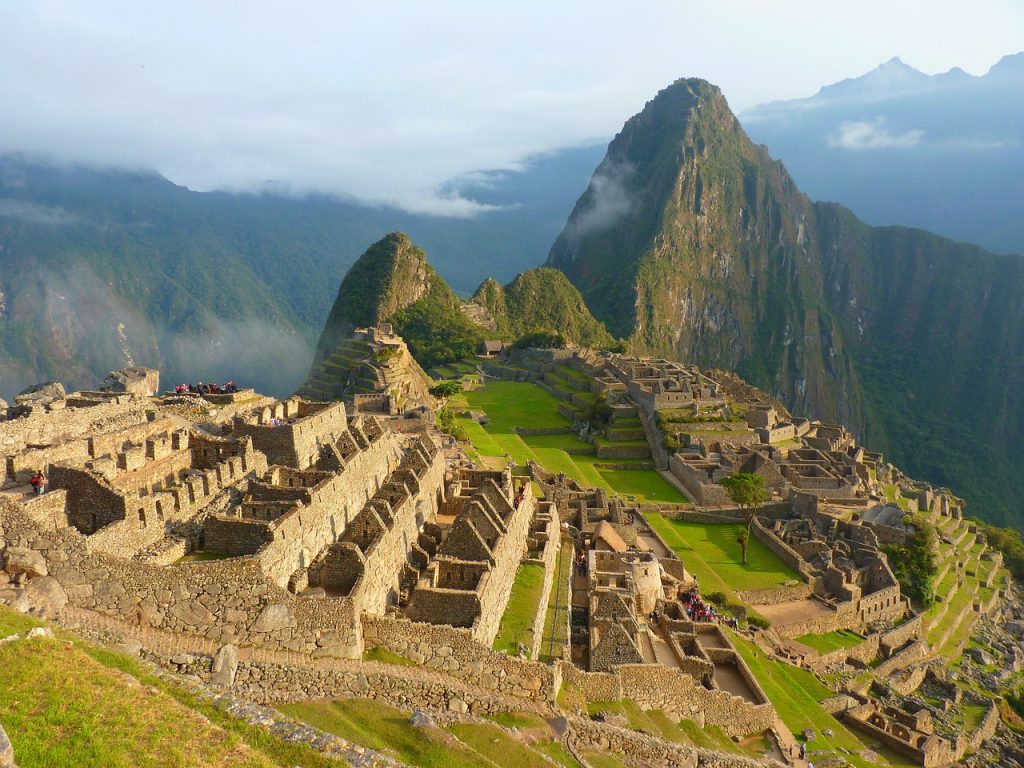
Nestled by the jungle, up in the Andes, Machu Picchu deserves its title: one of the new Seven Wonders of the World. Built without motor or wheel, Machu Picchu is so much more than a marvelous engineering project. Go beyond an Instagram picture, and learn about Inca, their connection with stars and land. There are just a few locations in this world where science and magic are so divinely perplexed. Machu Picchu is one of them.
With two main seasons, rainy (November – April) and dry (April – November), Machu Picchu is an all year round destination (exception is a month of February due to heavy rains).

Pisco Sour
(Yields: 1 drink)
Measurements:
• 2 ounces of Pisco.
• 1 Simple Syrup
• 1 Freshly squeezed passion fruit juice.
• 5 Ice cubes
• ½ egg white.
Procedure:
Shake all the ingredients together in a cocktail shaker until ice is broken down.
Service: Serve in a Martini cup, garnish with some drops of Angostura bitters on top of its foam.

Ch’uñu
Potato has been growing up in the Andes more than thousands of years. Today, Peru grows more than 3000 types of potatoes. One of the most common ingredients of Andes soups is ch’uñu, or frozen potato. Don’t be surprised when the locals tell you that this potato stays more than decades in their pantry.
Chuño is made at elevations of over 3,800 meters (12,500 ft) during June and July when the temperatures reach around −5 °C (23 °F). After the harvest, potatoes are spread on flat ground and allowed to freeze with the low night temperatures and dehydrate in the daytime, for about three nights. This process results in natural freeze-drying.